Thursday, June 30, 2016

The Legend of Robin Hood

Throughout the years, there have been multiple tellings and re-tellings of the story of Robin Hood in Sherwood forest with his band of Merry Men, stealing from the rich and giving to the poor. The references of Robin Hood begin in the year 1261. From 1261 onward, the name "Robin Hood" (sometimes spelled as Robinhood, Robehod, Robyn Hude) was used as a name for malefactors. 

Sightings of Robin Hood have been reported from all over England, however, according to legend, Robin Hood lived in Sherwood Forest. Sherwood Forest is a royal forest in Nottinghamshire in east England. The forest attracts between 360,000 to 1 million tourists annually and is home to the Major Oak, the oak tree that supposedly served as shelter for Robin Hood and his Merry Men. It weighs 23 tons and has a girth of 33 feet and a canopy of 92 feet. 

To this day, nobody knows if the legend of Robin Hood was based off of a real person or not. There are accounts of men who share shocking similarities. For example, Roger Godberd served under Simon de Monfort, just like Robin Hood. He was also exiled in 1267 after fighting King Henry III, just like Robin Hood. He then lived in Sherwood Forest for 5 years before being captured in 1272. During his time, he called upon other outlaws to help him avoid the authorities. It has also been hypothesized that "Robin Hood" may have been an alias used by many thieves. 

The story of Robin Hood has been told through the ages with the use of ballads, stories, books, plays and movies. Throughout time, people have forgotten that there was any truth to the story. When I think of Robin Hood, I don't think about a real-life outlaw, I think of a cute red fox in a tiny hat. Oftentimes, when people walk through the key room and see the key to the gates of Sherwood Forest, they immediately assume the key is fake and ask why we even display it. The truth is, nobody can prove that Robin Hood didn't exist. Furthermore, regardless of Robin Hood, Sherwood Forest exists. 

The key we have in our collection is not accompanied by much information. All we know is that it is a key to a gate of Sherwood Forest. According to the note, the wood that is attached is from one of the trees where Robin Hood stored his arrows. Although we don't know if The One And Only Robin Hood existed, we know that outlaws lived in Sherwood Forest and his their winnings and their supplies all over the area. For all we know, the attached bark could be from the Major Oak. 

Although we don't know all the facts about Robin Hood and his Merry Men, I like to think that this bark really did come from one of Robin Hood's trees. Because how incredible would it be if it did? 

Until next time!
Natalie

Wednesday, June 29, 2016

The Key That Failed a City

After finishing my book Devil in the White City yesterday (a book about the Columbia Exposition in Chicago) I was inspired to take a closer look at a key that I often point out to visitors - The Chicago Fire Box Key. Thanks to my History of Chicago professor, Chris Folk, I know a good deal about the affair.


The letter with the key reads:
At the time of the Chicago Fire, 1871, the fire alarm box stood at the corner of DeCoven and Desplaines Streets. This key is said to be the key that was chained on the inside of the box, behind the glass cover. After the Great Fire, the glass door type fire alarm boxes were replaced with the more modern type having a handle outside to be turned in case of fire.
Of course there were many factors that lead to the fire's "great" destruction. Several smaller fires occurred the week leading up to the great fire leaving behind dry, damaged debris that would later fuel even greater inferno. On top of this, the city struggled to keep water supplies clean and accessible.

At 9:00pm on Sunday the 8th of October, first reports of a fire are made. The Great Chicago Fire was in fact several smaller fires sparking and joining together. The fire burned through Sunday until early Tuesday morning.

Immediately after the fire, the Chicago Tribune ran a story blaming poor Mrs. O'Leary, an Irish Immigrant and farmer on the southwest side of the city otherwise known as the "Back of the Yards," for the start of the fire. As the legend goes, Mrs. O'Leary was out milking her cow late at night when the cow suddenly kicked over the lantern, thus setting the barn and surrounding area aflame. 


Chicago Tribune journalist, Michael Ahern, later admitted the story was entirely made up, but the damage was already done. Years later, people still talk and sing nursery rhymes about poor Mrs. O'Leary. 

...But perhaps this little key hidden away in our collections is more to blame?


Until next time, 
Zoe


Monday, June 27, 2016

Keys to the Future - Encryption Keys

Greetings!  Today's key is perhaps one of the most high-tech ones we have in our collection, and fully understanding it has been quite a challenge for me, so I'll be simplifying this significantly from all of the more specific technical terms.  I'm certainly no expert in the field of cyber security, but I'll do my best to make sure this makes sense.

This "key" that I'm talking about comes printed on a piece of paper in a frame.  Labeled as a "1024 bit Public Encryption Key", it contains several lines of randomized letters and numbers.  While we don't have a tag for it, the paper has at the bottom an author listed as Craig Robinson, who generated the key on June 10th, 2008, though it was a 2010 donation.


Of course, such an unusual key requires some explanation.  Why would we print a key on a piece of paper like this?  Well, there's actually no need for the physically printed key to exist.  The purpose of it is to be a digital key.  It's used in both sending and receiving information over the internet.  A simple similarity would be sending emails.  In order to send an email, you first have to use a password to log into your email.  Likewise, the person you send your email to has to use their password to log in and receive the sent email.  Encryption keys are fairly similar, on a more complex process.

This is all essentially based on pre-internet forms of encryption.  Think about espionage.  Spies that have to exchange information with each other without anyone else knowing about it may write a letter in code.  They would both have a key so that the sender could properly write it in code and the recipient could properly decode the message.  The same principle applies to internet security.  The message (such as the theoretical email you sent earlier) would be encoded so no one else would be able to read it.  This level of encryption keeps other people out.  While you may or may not care about people snooping in your email, encryption is much more appreciated in internet purchases, where the encryption keeps details about your credit card safe from people who would want to steal your card information.

An example of asymmetrical cryptography


Now, we need to establish the difference between a public key, like this one, and a private key.  This is part of a process known as "asymmetric cryptography".  The reason that it's asymmetric is because of the existence of the two keys.  The public key is only used to encrypt the information.  The access to that is much more extensive.  As shown in the diagram above, the public key would be used by the other party.  Your key, in this situation, would be the private key, which is the only way to decrypt the information.  The security depends on your private key remaining private.  The asymmetric system is frequently used in SSL security, also known as TLS, and keeps everything properly locked.  In fact, if you're using Chrome right now, you can click the lock button on the web address and view the "details" portion to see that your connection is secure via one of these asymmetric keys.

With that in mind, the definition of a 1024-bit key can be given.  Essentially, the 1024 bits refers to how long the key is.  Generally, the more bits in a key, the more secure it is.  Back when this key was written in 2008, 1024 bits was the standard for encryption keys.  Now, 8 years later, the new standard is 2048 bits, with options for 4096.  These longer keys are significantly harder to hack into, making them more secure than the old 1024 bit keys.

At this point, hopefully you understand more about internet security and the "keys" that go with them.  I've certainly learned quite a bit from researching this key.  Thank you (presumably) to Mr. Robinson for this key, and, as always, you can see this (and many others) when you visit the Key Room!

Topher

Sunday, June 26, 2016

Keys to the Past - Denver's Albany Hotel

Greetings!  Today's key comes straight from our "Orphan Key" collection.  Our orphan keys contain keys donated to us that have lost tags, or have tags that have faded so badly that they're illegible.  Today's key didn't come with a paper tag, but fortunately, we do have some documentation of where it came from.


This is the key to room 622 in the Albany Hotel in Denver, as noted by the front side of the tag.  As with most old hotel keys, it could be dropped in any mailbox to be returned to the hotel.  On the back of the tag is an advertisement for Continental Rent-a-Car, offering rates of 5 dollars a day, 5 cents a mile.  Wouldn't those prices be fantastic to have today?

The Albany Hotel was first built in 1885, as the product of architect E. P. Brink and financier W. H. Cox.  The vision for the hotel at the time was to provide Denver with an elegant hotel that combined elements of American hotels with French style.  Originally, the hotel featured 155 rooms, in addition to it being one of the few hotels in the city to have electricity in every room.  In 1912, the continued success of the hotel led to the addition of a new annex.  The Salida Mail remarked that the annex held an additional 120 rooms, each with a private bath of its own, which was a big deal at the time.

The original Albany Hotel


The hotel was one of Denver's more notable ones in the early 1900s, with additions adding more features, like a trout pond and continued bathroom renovations.  Large-scale events, including the 1908 Democratic National Convention and the 1906 National Elks Convention, were hosted, and the hotel boasted plenty of famous guests, including Buffalo Bill.  The popularity of the National Western Stock Show also meant that many cowboys and cowgirls would frequent the establishment as well.

Perhaps the biggest issue with the Albany Hotel was its instability in ownership.  The hotel frequently changed owners, usually every few years.  In the 1930s, the newest owners decided to tear down much of the hotel and rebuild it, re-opening in 1938.  The rebuilt portion of the hotel was designed to better match the earlier annex.  Unfortunately, the continued ownership changes helped contribute to the decline of the hotel.  In 1976, after years of slow business, the Albany Hotel shut its doors for good.  It was demolished on November 17th, 1976, to be replaced by a new office building.

The interior of the Albany Hotel's 1912 annex

In the end, the failure of the Albany Hotel was a multitude of factors - an aging facility, inconsistent owners, and an overall lack of business.  The old elegance and charm of the building simply couldn't hold up as well against newer hotels.  The Windsor Hotel, one of the Albany's main competitors from the time period, also came to a similar ending when it was demolished in 1960.  Here at the Baldpate, we are especially fortunate to have made it much longer than the Albany Hotel.

Unfortunately, research into the Continental Rent-a-Car Company from the back side of the key came up with nothing but dead ends, implying the business has been long gone.  But, the low prices prove to be a sign of the times - diners could get lobster at the Albany Hotel's dining room for only 75 cents a hundred years ago.

As always, thank you for joining me on this trip through time!  Though it is regrettable that we don't have the key's paper tag, or that we don't know who provided us with this fantastic key, we remain thankful for the donation.  Bring in your keys (and the stories they tell) to the Key Room!

Topher

Saturday, June 25, 2016

Keys to Heaven


In the Gospel of Mathew 16:19, Jesus says to St. Peter, "I will give you the keys to the kingdom of heaven and whatever you bind on Earth will be bound in heaven, and whatever you loose on Earth will be loosed in heaven."

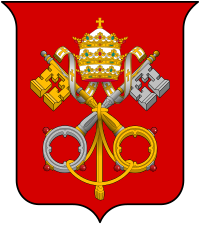
Since the creation of the Catholic Church, the image of St. Peter's keys to heaven has been seen on papal coats of arms and all over the Vatican. In fact, the keys to the Iron Door at the Vatican were modeled after the keys to heaven that Jesus gave to Peter.


In the back corner of our key room, we have a replica of the key to the Iron Door of the Vatican. Although the label states that the key is from 1950, the letter attached to the back of the key states that the key was collected by John K. Major in a 1932 trip to Rome. He was 8 years old at the time. It was attached to a ticket to the private museum of the pope (during this time Pope Pius XI). When John K. Major donated this key to heaven years later, he included this poem:

"After viewing your collection,
I've finally made up my mind. 
I'll add another to your group
Of a very peculiar kind.

This type of key I found in Rome,
It was for the Vatican,
Where I used to roam and roam,
In it were things from every lan'.

This key was on the ticket,
To the Pope's Private Museum,
It was his own insignia,
Under the tiara built for him.

This key's supposed to open heaven
The one Christ gave to St. Peter,
Two keys together form an X,
Under the Crown of the Catholic Leader.

The Crown in called the  Triple Tiara,
A tall Tiara with Three Great Rings
Of costly jewels circling it,
A Holy Thing above all Things.

Since this is all I need to tell,
I'll enclose the ticket itself I need to tell,
Then I'll just say farewell,
And not bother you anymore with terrible poetry that doesn't rhyme."


Until next time,
Natalie


Friday, June 24, 2016

Summer Solstice

Happy Flip Flop Friday from the Baldpate!

Today we are celebrating summer with Summer Solstice in The Keys featuring Key Lime and Coconut Cream Pies with Corona and New Belgium Beers.While everyone is enjoying that in the dinning room, I am in the Key Room finding more and more keys to admire and share with all of you.

Today, I bring you thoughts of warmer, sunnier places as we look at hotel keys and their evolution throughout the years.

During my time in the Key Room, visitors have commented on our hotel key collections, especially the Epperson’s collection of  keys from their travels as a married couple. These keys in particular were donated in October 2006 by their son, Peter Epperson, after both John and Stella passed away. 


Although these are worth discussing, visitors’ comments usually relate to the fact metal hotel keys are rapidly approaching extinction. 

Before the invention of the plastic key cards in 1975, hotels operated using metal keys (a practice the Baldpate still uses today) with plastic key tags displaying the name of the hotel, room number and a certified stamp guaranteeing postage if returned. Because changing locks was expensive and required a lot of work, if someone found a lost key, or forgot to return their key at check out - all they had to do was drop the key in a mailbox and it would be returned to the hotel. 

When the plastic key came about, it operated through different combinations of thirty-two holes in the card. Later the holes were replaced with a magnetic strip. These quickly became the most popular form of key in the hotel industry around the world today. With every new guest, key cards are reprogrammed to include information like the guest’s name and room number. Another advantage of key cards is they usually deactivate after checkout, eliminating the need to track down lost keys.

One of the most recent innovations in key cards is the RFID (radio frequency identification) card. As the name suggests, this type of key card uses a specific radio frequency instead of a magnetic strip to open locks. This type does not have to be swiped like the magnetic strip key cards, so it is held in front of the lock instead.

Like I said, The Baldpate, as a tribute to its Key Room and commitment to tradition continues to use metal keys for its rooms. 

Signing off,
Zoe

Thursday, June 23, 2016

The Key to the First Atomic Bomb

  Good morning key lovers!

   It is a sort of rainy and gloomy morning here at The Baldpate Inn, so I have decided to focus on a key with a darker context- the key to the laboratory in which the first atomic bomb was worked on.


  The atomic bomb's origins go all the way back to the year 1932, when James Chadwick discovered the neutron- an atomic particle with mass but no charge.  By 1941, atomic research and work was being done in 12 American universities, one of them being the University of Chicago, where our key for the day comes from.  Enrico Fermi's team at Chicago was able to create a sustained chain reaction of fission for the first time.

  Stated on the letter below, Wayne Whittaker says, "Let's hope that this key symbolizes more than the terrifying atom bomb; that nuclear science will eventually give us a happier, healthier world."  This can be considered a very controversial statement, as nuclear science and the invention of the atomic bomb are already extremely touchy topics.  Whittaker also says that this world includes an "old-fashioned friendliness" that "reigns supreme" at the Baldpate Inn.


   We could go on all day about debates regarding the atomic bomb, but that is where I will leave the topic for today.  Come join us for some hot Baldpate soup on this gloomy day, and enjoy the rest of your afternoon!

  Signing off,
Hunter