Sunday, June 1, 2014


Good Afternoon,

On this lovely Sunday afternoon I would like to present my first post on this blog as one of the Key Room Curators for this summer. My name is Jake and I am from Illinois. I just graduated from college with two bachelor’s degrees in History and Political Science. This summer I and my fellow curators will be bringing you a look into some of the unique keys that we have here in our collection.

My first key I would like to present as my portion of this blog is the Edith Rockefeller-McCormick Key. This family of course has a long history and I would like to take a moment to give a brief background of them. As many may know the Rockefeller family was very wealthy, due to the founding of Standard Oil by Edith’s father, John Davidson Rockefeller. She was born the fifth child and the fourth daughter of John Davidson Rockefeller and a schoolteacher named Laura Spelman. There is rumor for there to have been some tension between Edith and her father due to her extravagance and her father’s desire to be frugal with the money he earned. She then married the heir to the mechanical reaper fortune, Harold Fowler McCormick at the age of 23. After this marriage, she then began to spend money even more freely in her new home of Chicago without the watchful eye of her father. While this marriage was not to last (ending in 1921), it threw Edith even more so into the public spotlight as a philanthropist and also an activist.

This particular key was given to us after her death in 1932 by Gertrude M. Moore, the manager of a women’s club that Edith Rockefeller-McCormick was a member of during her time in Chicago. Gertrude M. Moore had originally intended to send us this key directly after the death of Edith Rockefeller- McCormick but unfortunately it was misplaced for nearly fourteen years until it was sent with a letter explaining the situation on October 19th, 1946.

This key is one of many here at the Baldpate Inn that has a very rich history and I and my fellow curators will be expanding upon many others this summer. Until next time my fellow historians, may you continue to grow in your knowledge of history as I hope to do.

Jake
Key Room Museum Curator

Saturday, May 31, 2014


Hello, everybody!

I have some exciting news to share in today’s Key Room blog, but I would first like to introduce myself. My name is Margie, and I’ve travelled all the way from Pennsylvania to experience the beauty of Colorado and the magic of the Baldpate Inn for the summer. I will be going into my second year of college at Penn State University, and I plan to double major in Arts Administration and Communications. I am thrilled to have the opportunity to intern in our museum, which has such an interesting collection, and be part of the Baldpate family!

                Now that we have that out of the way, I’ll tell you the great news. I had the privilege the other day of meeting the granddaughter and great granddaughter of Clarence Ison, who built the Keystone for our fireplace in the Key Room. Reverend Jean Waldron and Shannon Trigg, Clarence’s granddaughter and great granddaughter, were able to give me some information and told me to call Clarence’s daughter, Nancy Weatherbie, for the rest of the story. Well, I had a very nice conversation with Ms. Weatherbie over the phone, and she provided me with a great deal of information about Clarence’s life.

                Clarence Ison was born in Missouri and lived in Platner, Colorado. Before he started a family, he moved to California and worked as a Deputy Sherriff.  He moved back to Colorado and was married. He and his wife later had three children. He was a stonemason and worked for a monument company in Longmont, Colorado. Ms. Weatherbie informed me, though, that he started as a farmer, and she describes him as a “jack of all trades.” As I mentioned, Clarence built the Keystone for the fireplace in the Baldpate’s Key Room. He also worked with Coalie Coleman, a relative by marriage, to build St. Catherine’s Church. The church is a gorgeous stone structure on Highway 7, a few miles away from the Baldpate. Clarence moved with his family to San Diego in May of 1941, where he again worked as a stonemason. After the war broke out, he worked in two aircraft factories. Ms. Weatherbie says that her father took so much pride in all of his work.

We, here at the Baldpate, are so thankful for his work on our Keystone, and we are thankful to his family for sharing this piece of history with us.

We hope you come by the Baldpate soon to experience more of our rich history!


Margie

Key Room Museum Curator  


Wednesday, May 21, 2014

New Season, New Team


Welcome to the Baldpate Inn Key Room Blog! We are excited for another season of sharing our collection and the history of the historic Baldpate Inn with all of you. Our collection of over 30,000 keys is full of endless stories to be shared and appreciated, and we cannot wait to display the fascinating history that our key room has to offer. Our names are Margie, Rachel, and Jake, and we will be your museum team for this 2014 season. We can’t wait to unlock our collection for you!
 

Sunday, March 23, 2014

It's a small world

Couldn't help but share this incredible story written from one of our esteemed guests!   

http://saturdaybriefing.outrigger.com/featured-post/the-rest-of-the-story

The Rest of the Story
BY DR. RICHARD KELLEY 

In today’s universe of almost instant communications facilitated by the Internet, we often find surprising links between people, places and things. That happened to me this week in Colorado, and the heartwarming story unexpectedly connects a current, front-page news item with bit of the history of an old family-operated inn near Estes Park, Colorado, with a more modern family-operated hotel company in the Pacific, and with a Colorado state trooper injured this week while trying to stop a bizarre serial carjacking.

Stories like this were the specialty of veteran ABC radio broadcaster Paul Harvey, who, for many decades, connected apparently widely separated people, places and events with a final bit of information. When adding that last, culminating fact, Harvey would proudly announce, “And now you know the rest of the story.”

Islander Hotel, Honolulu, HawaiiToday’s story started last year when I visited Estes Park, Colorado, the gateway to Rocky Mountain National Park, and had lunch at the historic Baldpate Inn. There I learned that Ethel and Gordon Mace along with Gordon’s brothers, Charles and Stuart Mace, homesteaded this beautiful piece of property in 1911. They built a cabin and grew rhubarb to comply with the provisions of the Homestead Act. To supplement their income, they added tourist cabins and, by 1917, added the Baldpate Inn with several bedrooms and a dining room. They used natural, local resources such as hand-hewn timber for beams for the structure and local stones from the riverbed to line their fireplace. They boasted about the inn’s hot running water, electric lights and indoor plumbing, which were unusual amenities in that area in those days.
The name Baldpate came from the mystery novel, Seven Keys to Baldpate by Earl Derr Biggers, which, also in 1917, became a silent-film mystery thriller. The author created seven visitors who traveled to a closed-in-winter hotel, each possessing a key that they believed was the only key to the property.

In keeping with the novel’s storyline, the Mace Family began giving all visitors their own key, which they could keep as a souvenir. However, the shortage and cost of metal during World War I soon forced them to stop that practice. Disappointed guests turned the tradition around and began bringing their own keys, and a competition began to see who could bring the most exotic or unusual key. The Maces encouraged this by dedicating a room to display the keys. A few years went by and they had to add another room. Now, with over 20,000 keys, “including examples from the Pentagon, Westminster Abby, Mozart’s Wine Cellar, and even Frankenstein’s castle, to name a few, the Baldpate is working with American History Savers to preserve and catalogue” the collection.

While having lunch, my wife Linda and I had a chance to speak with current owner, Lois Hoke Smith, a dynamic person who is dedicated to keeping the Baldpate Inn as the best country inn in Colorado.
We asked her if the Baldpate key collection might contain any keys from one of the hotels operated by Outrigger Enterprises, its predecessors or even Roy and Estelle Kelley in their young, entrepreneurial years. She personally took us to the key rooms. Keys were everywhere – on the walls, on the columns, on the beams, on the ceilings! We looked and looked and then, VOILA!!! We found a well-preserved key and bright key tag for

The Islander Hotel, of course, is where Outrigger Enterprises began when Roy and Estelle welcomed the first guest to their just-completed building in 1947. Serving pineapple juice on the patio and folding towels in Housekeeping were Richard, Jean and Patricia Kelley, who had not quite turned 14, 12 and 10 years old.

Finding that key at Baldpate was very emotional for me, particularly because one of my early duties was to cut replacement keys when they were lost or not returned by guests.
Now flash forward at “warp speed” to this past Wednesday, March 13. Allan Rodriguez, age 4, sat alone in a Ford Edge SUV at a Bradley service station in Longmont, Colorado, about 30 miles from the Baldpate Inn while his mother went inside to pick up a cup of coffee. In a flash, a stranger hijacked the vehicle with Allan inside. Police and a news helicopter were almost immediately on the hijacker’s tail and a wild, 60-mile chase ensued during which the hijacker took over two more vehicles and ran over and seriously injured a Colorado State Trooper by the last name of Hee

At that point, I received an email from my daughter, Linda Jane Kelley, telling me that Trooper Hee’s full name was Bellamann Hee, Junior, her classmate at Punahou School in Honolulu. His father, Bellamann Hee, Senior, was born in Shanghai, China. In Hawai‘i, Bellamann Senior founded Bellamann Services, Inc., a company that sold signs and other promotional products. Mr. Hee, Senior, passed away on May 17, 2013.

I remember Bellamann Senior as a kind, gentle and loving man who provided our growing companies with engraved plastic signs that we used all around our hotels. We also bought other plastic products from Bellamann Services including, guess what, plastic room key tags!
Once again, we discovered what a “small world” we inhabit.
State Trooper Hee who was injured in this week’s triple hijacking in Colorado, grew up in Hawai‘i. It is highly likely that his father was the person who sold the room key tags to our Islander Hotel in Waikīkī many years ago. One of those key tags ended up in the Baldpate Inn, Estes Park, just over 30 miles from where the first carjacking occurred.

“And now you know the rest of the story!”
P.S.: Trooper Hee is currently hospitalized with serious injuries but is reported to be doing well and on what may prove to be a long road to recovery. And young Allan Rodriguez was returned safe and sound to his mother.

Sunday, August 25, 2013

From Key to Key Card

Ever wonder why keys were created?
Well, once people had stuff, they wanted to protect it.
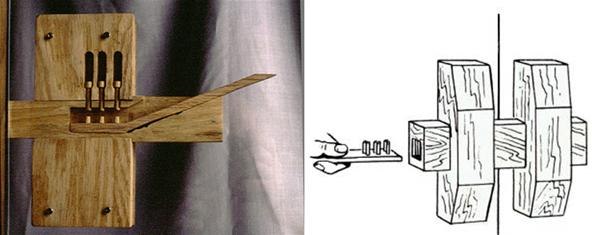
The first keys (and their locks) appeared over five thousand years ago in ancient Assyria and Egypt. They were large, cumbersome, and made of natural materials, particularly wood. These were not the best keys for protecting peoples’ goods, but they did help signal whether an actual or attempted theft had occurred. Made of iron and bronze, ancient Roman keys were smaller and sturdier than early wood ones, yet they were still not the perfect safeguard. Worn on a string or on a person’s finger, these keys symbolized wealth more than anything else. 
Ancient Assyrian Key & Lock
Keys’ function as status symbols continued throughout the Medieval period, while the amount of ornamentation on them increased. The bows (the part of the key you hold) became especially ornate to resemble the intricate rose and stained glass windows in cathedrals. It wasn't until the 1800s that inventors, especially Linus Yale Sr. and Jr., created the modern tumbler locks and the “flat keys” we use today.
Or rather, the keys we used to use.
All season long during my time in the Key Room, visitors have commented on our hotel key collections. They especially comment on the Epperson’s stunning set of international keys from their adventures as a married couple. These keys in particular were donated in October 2006 by their son, Peter Epperson, after both John and Stella passed away. Although these are worth discussing, visitors’ comments usually relate to the fact metal hotel keys are rapidly approaching extinction.
Epperson's Hotel Key Collection


Plastic key cards were invented in 1975 by Tor Sornes and were specifically designed for use in hotels. These keys operated through different combinations of thirty-two holes in the card. Later the holes were replaced with a magnetic strip. These quickly became the most popular form of key in the hotel industry around the world. With every new guest, key cards are reprogrammed to include information like the guest’s name and room number. Another advantage of key cards is they usually deactivate after checkout, eliminating the need to track down lost keys.
One of the most recent innovations in key cards is the RFID (radio frequency identification) card. As the name suggests, this type of key card uses a specific radio frequency instead of a magnetic strip to open locks. This type does not have to be swiped like the magnetic strip key cards, so it is held in front of the lock instead.
Donated Key Cards
To keep with our rustic roots, The Baldpate still uses ‘old-fashioned’ flat keys to unlock guest rooms, and our Key Room will always feature the metal keys previously used to by other hotels. Come by before the season’s over to see these keys that may soon be relegated to history!
                                         

Caitlyn
Key Room Museum Curator 

Friday, July 12, 2013

The Grandest of Them All


Today, the Key Room is highlighting a set of keys that cannot open a physical door, but can unlock the doors to inspiration and creativity. The keys in mention are a set of seven piano keys (keys 33-39 to be exact) from one of the first grand pianos in Denver, CO donated to the Key  Room by Ray Hamilton.

*Interesting fact: The piano has earned the moniker “The King of Instruments” primarily for its wide tonal range. The piano can reach the lowest note of the contrabassoon and the highest note of the piccolo. There is no other orchestral instrument that can match its complete tonal range.


 Though I could not find any information on who Ray Hamilton was, we here at the Inn are very appreciative of his donation and proud to have it displayed in the “Musical Keys” section of our Key Room.

Come See!

 
Cameron
Key Room Museum Curator


Wednesday, July 10, 2013

Small and Mighty

        After the question which is the most famous key, visitors most often ask us what is the oldest key in our Key Room. The answer appears unassuming at first: a small ivory ankh.
 
        The ankh is the ancient Egyptian symbol and hieroglyphic sign for life. They are ubiquitous in ancient Egyptian art and decoration and are commonly displayed with gods and goddesses. Deities such as Isis, Osiris, Ptah, Satet, Ra, Hathor, and Anubis were depicted holding ankhs. I once saw a statue of Sekhmet—the Egyptian goddess of vengeance and retribution, as well as healing—at the Denver Museum of Nature and Science. The great stone figure, regal with a sun disk poised on her lion head, offered the viewer an ankh and thus offered life. The sign’s connection with immortals and the loop’s lack of beginning or end do not just entail life for the living but also eternal life for the deceased. Ankhs were used in funeral ceremonies, and the dead were called "ankhu." A sarcophagus was also called "neb-ankh," which means "possessor of life."
Statue of Sekhmet
        Originally, the ankh was thought by historians to signify sandals, the loop the part of the shoe intended to be placed around the ankle. It is also believed to have been used as a sign of initiation into sacred mysteries by placing it on a person’s forehead between the eyes; in this way it acted as a key locking the knowledge away from the uninitiated. Additionally, the ankh could be associated to the “Knot of Isis,” which was representative of mirror opposites like life and death, since the word ankh was also used for mirror. Another interpretation is that the loop suggests the path of the Nile delta, while the horizontal bar represents the unification of East and West. This may explain another reason why the ankh is connected with life: water is the ultimate sustainer of life. In the desert there is no life without it.
        Even though the ankh is Egyptian, we in Colorado understand water as a source of life and sustenance. With summer halfway over, we hope our ankh will continue to bring us rain and stave off wildfires. If you’d like to see this little piece of ancient history and decide which interpretation you like most for the “Key of Life,” come visit us at the Key Room!

Caitlyn
Key Room Museum Curator