Our key today comes all the way from Washington DC, and if you like to travel, I think you'll especially like this key!
This key opens the front door of the United States Travel Bureau in Washington DC. The key was donated in 1941 by W. Bruce Macnamee, who worked for this department of the government. As someone who worked with National Parks, I'm sure the Baldpate being right next to Rocky Mountain National Park was a great delight for him. He kindly sent the key and encouraged them to visit whenever possible.
The Travel Bureau was started in 1937 as a way to promote National Parks to both US citizens and international visitors. It opened using emergency funds and the founders hoped Congress would legitimize it with a budget, which they did by 1940. The Bureau was used to promote American tourism by publishing pamphlets and also attending fairs to encourage people to explore their own country. A lot of now retro posters of National Parks used for marketing back then were created by this Bureau and some are still used as marketing tools today.
Unfortunately, World War II would be the demise of the Travel Bureau, as it would not make it into the fiscal budget of 1942, signalling its end by 1943. Though it was short lived, the Travel Bureau sparked a love of cross country exploration in the American people that would persist until even today.
Today, the Bureau of Consular Affairs is the modern day equivalent and functions in a similar way that the Travel Bureau did. It was started in 1979 and has some of the original functions that the Travel Bureau had but also encompasses a lot more.
There's so many interesting keys like this one in our collection, so head on up to our key room and take a look around for yourself! In the past two years we've been working on a new feature in our key room so you can learn about our keys if there's not a curator present! Just download a QR code reader and then scan the codes by different keys and it'll take you to a blog post just like this one!
Written by: Victoria Witkowski, Museum Curator
Source Used
Everglades
Garden of the Gods
Sharing the story and legacy of The Baldpate Inn which has been enchanting travelers for 103 years!
Sunday, July 8, 2018
Saturday, June 30, 2018
Smo-"Key" the Dog
Attention dog lovers, this one is for you!
If you've been to the Baldpate, you know we have keys of all sorts: sock mon-"keys", piano keys, and many others. While we have many famous keys in our collection, sometimes the lesser known stories that hang on our walls deserve showcasing as well.
Smo-"Key" the German Shepherd is no exception. Smoky belonged to Mr. and Mrs. Henry Wagner of Greeley, Colorado and was their beloved companion for many years. This picture was donated by couple in 1937 after a recent trip up to the Baldpate and visiting the key collection. After the visit, Smoky donned a lock on his collar, as he was the key, creating a complete set. They thought the play on words that came from his name was a clever way to honor their beloved pup and also make a contribution to our collection, as they had greatly enjoyed the company of Gordon and Ethel during their visit.
Moose, the Baldpate's German Shepherd, offers companionship to all our staff and visitors just as Smoky did to the Wagners. Though he doesn't have a "key" in his name, he's still a very important member of our Baldpate family.
There are so many stories here in our key room waiting to be told- Smoky and the Wagners are just an example of countless tales all our pictures, keys, and objects tell. Come up for a visit and discover all the stories waiting to be told (and maybe give Moose a pat hello)!
Written by:
Victoria Witkowski, Museum Curator
If you've been to the Baldpate, you know we have keys of all sorts: sock mon-"keys", piano keys, and many others. While we have many famous keys in our collection, sometimes the lesser known stories that hang on our walls deserve showcasing as well.
Smo-"Key" the German Shepherd is no exception. Smoky belonged to Mr. and Mrs. Henry Wagner of Greeley, Colorado and was their beloved companion for many years. This picture was donated by couple in 1937 after a recent trip up to the Baldpate and visiting the key collection. After the visit, Smoky donned a lock on his collar, as he was the key, creating a complete set. They thought the play on words that came from his name was a clever way to honor their beloved pup and also make a contribution to our collection, as they had greatly enjoyed the company of Gordon and Ethel during their visit.
Moose, the Baldpate's German Shepherd, offers companionship to all our staff and visitors just as Smoky did to the Wagners. Though he doesn't have a "key" in his name, he's still a very important member of our Baldpate family.
There are so many stories here in our key room waiting to be told- Smoky and the Wagners are just an example of countless tales all our pictures, keys, and objects tell. Come up for a visit and discover all the stories waiting to be told (and maybe give Moose a pat hello)!
Written by:
Victoria Witkowski, Museum Curator
Monday, June 18, 2018
Welcome Back!
Welcome to our 101st season everyone!
We’re happy to see familiar and new faces in our key room
this year so far, but if you haven’t been able to visit again or for the first
time, we’d love for you to come back! I was one of the curators last year and I’m back for a second year in key room
and would love to show you around.
Yesterday was our 101st birthday so in honor of
that I’d like to show you some of my favorite Baldpate related items!
Did you know that the town we call home, Estes Park, is only
a few weeks older than the Baldpate? Gordon and Ethel Mace homesteaded just
outside the main town and opened the bed and breakfast to allow folks to enjoy
our beautiful mountain views.
![]() |
| One of Charles Mace's cameras |
If you've visited us before, you’re probably familiar with the hundreds of photographs
that decorate our halls but did you know that all the pictures that line our
walls were taken by Gordon’s brother Charles? He was a photographer following a
few major generals in World War II and then continued his career as a
photographer for the Denver Post. When it was time to retire, Charles found himself
in possession of countless pictures he’d taken over his career, so Gordon and
Charles decided the best course of action was to put the photos up in the Inn,
where they’ve been ever since.
Our key room boasts over 30,000 keys, but we have two keys
that claim to be the first. One is by playwright George M. Cohan, the man who
is responsible for the play and earliest movie adaption of our namesake novel
by Earl Derr Biggers. The second comes from famed lawyer Clarence Darrow, who
is perhaps most well-known for his work on the Scopes Monkey Trial. This trial
would put him on the map and solidify his career. Both these famous guests of
the Baldpate donated their keys in 1923, but since the exact dates of donation
are not known, it look like it’s impossible to know which key really is the “first”
key to Baldpate.
All of our keys tell a fascinating story and the photographs
are a delight to look at which makes a trip to the Baldpate a surefire way to
turn any afternoon around. Thanks for strolling down memory lane with us today
and we hope to see you in our key room soon!
Written by:
Victoria Witkowski, returning Museum Curator
Monday, August 14, 2017
Key to the Royal Tombs of Egypt
Good morning key lovers!
Today, I will take you half way around the world to explore
a key that comes from the royal tombs in Egypt. The key is from the lock on the
crypt where Ibrahim Pasha is entombed at the tombs of the califs dating to 600
A.D. “Ibrahim Pasha was the son of Mohamed Ala, the first Egyptian ruler and
was the great emancipator of the Egyptians.” Pasha started off as a general in
the Egyptian army as a teenager. He succeeded his father, who was the ruler of
Egypt and Sudan, after he became ill. However, he died before his father, only
four months after taking the throne.
| Ibrahim Pasha |
The attached note says that the “key was obtained by Richard
Spencer on his trip around the world in 1937.” There is now a monument erected to
Pasha in Cairo. He was heralded as one of the greatest leaders of his dynasty
due to his sweeping military victories. What other keys to royalty may be
hidden among our walls?
| Key to Pasha's crypt |
Written by:
Brett Meyer
Museum Curator, Baldpate Inn
References:
Saturday, August 12, 2017
A Polish Palace
Good afternoon everyone!
This summer sure has flown by quickly, and I find
myself on my second to last day here at the Baldpate before heading back to
school. It's crazy how fast the summer has gone! Since it's my last time in the
key room, I wanted to share with you all one of my favorite keys that I've come
to love after spending my summer in the key room.
When I was browsing the key room when I first got here this
summer, this large key immediately caught my eye, but it wasn’t until a little
later that I actually took some time to research it. I knew some preliminary information
about the Wilanów Palace, but in my free time I was
determined to learn some more about it.
| Key donated by Mrs. Sophia Zaleski Hinkle, longtime donor to our collection |
| Letter from Sophia, giving information about the key and including a picture of the palace at the time of donation, 1936. |
![]() |
| The palace as it is today |
Finally, after recovering from a spell of being neglected, the palace was returned to the splendor it was intended to have and was opened as one of the very first museums in Poland in 1805. The magnificent building was kept in pristine condition and had many rooms preserved in it. One of the most famous was the stark white hall built after King John’s time, which boasted a welcoming large white room for all. Others include chambers where parties would be held and bedrooms fit for kings.
![]() |
| The infamous White Hall, located near the palace entrance |
Another hallmark of the palace is the portrait gallery that
contains priceless paintings of Polish royalty and other influential members of
the country’s past. These frames are preserved for all to look at even today,
and tell the tale of many rulers time has forgotten.
![]() |
| A view down one of the hallways of the portrait gallery in the palace |
I love this key because as it leads to one of the most beautiful palaces that the world has sometimes forgotten and it makes me feel connected to my family history, as we have a long, long line of Polish decent. There’s so many amazing stories to
historical buildings and palaces alike in our key collection just waiting to be
discovered. Come over for yourself and check them out before we close for the
season in October!
Written by:
Victoria Witkowski, Museum Curator
Source (for info and images):
Friday, August 11, 2017
Lindbergh Law
Good morning key scholars!
Today’s key has a unique connection to Charles Lindbergh, the
famous transatlantic pilot of the Spirit of St. Louis, and a piece of legislative
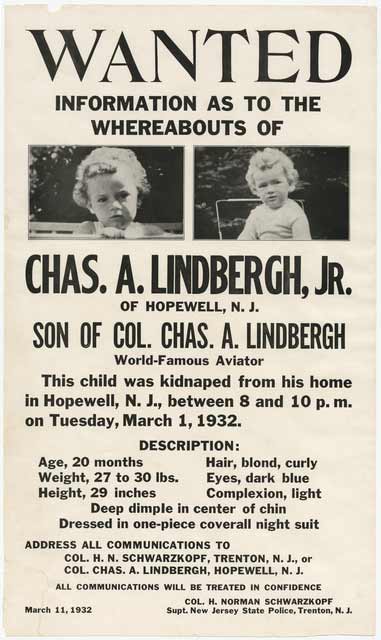
history. On March 1, 1932, Charles and his wife’s child, Charles Jr., was
kidnapped and murdered. Because of their high profile status, the nation was
outraged by the crime against the Lindberghs. It took two years, but Bruno
Richard Hauptmann was finally arrested for the kidnap and murder, before being
convicted and executed in 1936. ¹
![]() |
| Charles Lindbergh Jr. was kidnapped in 1932 |
As a result of the popularity of this trial, the 1932
Federal Kidnapping Act, popularly called the Lindbergh Law, was passed. The law
stated that it is “a federal offense to kidnap someone with the intent to seek
a ransom or reward.”² Today’s key is connected directly to the implementation of
this law. The key is to the handcuffs that were used on Arthur Gooch, the only
person at that time to have been executed under the Lindbergh Law. The attached
letter states that not only was Gooch the first person to be executed under the
law, the same night his guilty verdict was returned, a jury convicted Hauptmann
to death for his murder of Charles Jr.
| Arthur Gooch |
Below is the full content of the attached letter:
Gentlemen:
I understand you have accumulated a rare collection of historic keys and am enclosing one I feel will add materially to the value of your collection.
Attached hereto is the handcuff key used by a deputy United States marshal in the eastern district of Oklahoma to shackle Arthur Gooch, the only man in America so far executed under the Lindbergh Law, when he was transported from the city-federal hail at Muskogee, Oklahoma, to the state penitentiary at McAlester, Oklahoma, for incarceration in the death row.
Gooch, an escaped prisoner from the Hughes County, Oklahoma, jail was arrested on December 26, 1934, after having kidnapped two policeman in Paris, Texas, on November 26, 1934, and brought them across the state line into Oklahoma. He was indicted on May 30, 1935, and on June 10, 1935, the jury returned a verdict of guilty and assessed the punishment of hanging.
On June 19, 1935, Honorable Robert Lee Williams, Federal Judge for the Eastern District of Oklahoma, sentenced Gooch to hang setting the date of the execution for Friday, September 13, 1935. Gooch, however, immediately appealed to the 10th Circuit Court of Appeals at Denver. The case went to the Supreme Court of the United States, where the offense was ruled a violation of the Lindbergh Law, and the Supreme Court later refuse to take the appeal on a writ of certiorari. The mandate was returned and filed in the office of the U.S. Court Clerk on April 22, 1936. On Friday, June 19, 1936, the death warrant was returned to the clerk showing that the order of the court had been carried out, that Arthur Gooch had been executed at McAlester, Oklahoma, at 5 o’clock that morning.
To date, no other person has been hanged for the same offense.
Another odd angle to the case is that the indictment against Gooch was returned the same night jury at Trenton, N.J., dommed Bruno Richard Hauptmann to die for the murder of the Lindbergh baby. It was Hauptmann’s offense which caused Congress to pass the law under which Gooch was executed.
I trust this key may find a place in your collection.
Sincerely yours,
John E. Tidwell
| Key to Arthur Gooch's handcuffs |
It is amazing how some of these keys are connected to famous
people and famous events in the history of the U.S. Come find out for
yourselves!
Written by:
Brett Meyer
Museum Curator, Baldpate Inn
References:
Sunday, August 6, 2017
The Duke of Wellington
Hello friends of the Key Room!
It has been a few days since our last post but today’s
should make up for our absence. The key for today belonged to the famous first Duke
of Wellington, Arthur Wellesley. The Duke is famous for his role in the Napoleonic
Wars. This key, which was to his soap box, was carried with him through his
most famous military achievement: the Battle of Waterloo. It was during this
battle, in 1815, that the Duke of Wellington shared in the victory of Napoleon.
Later in life, the Duke became the prime minister of Britain
and was praised for his honest character and as an uncorrupt politician. We were
fortunate enough to be given this key by Mrs. Rex Philips Johnson who says she
kept the soap box that the key belongs to. Though this key is small, it unlocks
an important part of history and connects us to the “conquer of the world’s
conquer.” What other keys might we have that are linked to major events in the
world’s history? Come check it out for yourself!
Written by:
Brett Meyer
Museum Curator, Baldpate Inn
References:
Subscribe to:
Posts (Atom)